HVAC ANSWERS · COOLING AND HEATING PROBLEMS
Ice or frozen coil
Residential guidance with direct answers, useful observations, and clear next steps.
Updated
Quick answer
Turn cooling off if ice is visible and do not chip or melt it with tools or heat. A frozen system can be associated with restricted airflow or other operating problems, and continued operation can cause damage. A qualified technician should inspect the filter, airflow, coil condition, blower operation, controls, drainage, and refrigerant circuit after the ice has thawed.
Understand the issue
An indoor cooling coil can freeze when its surface becomes too cold. Restricted airflow and refrigerant-circuit problems are among the possibilities. Visible ice is a symptom, not proof that refrigerant needs to be added.
Your questions, answered
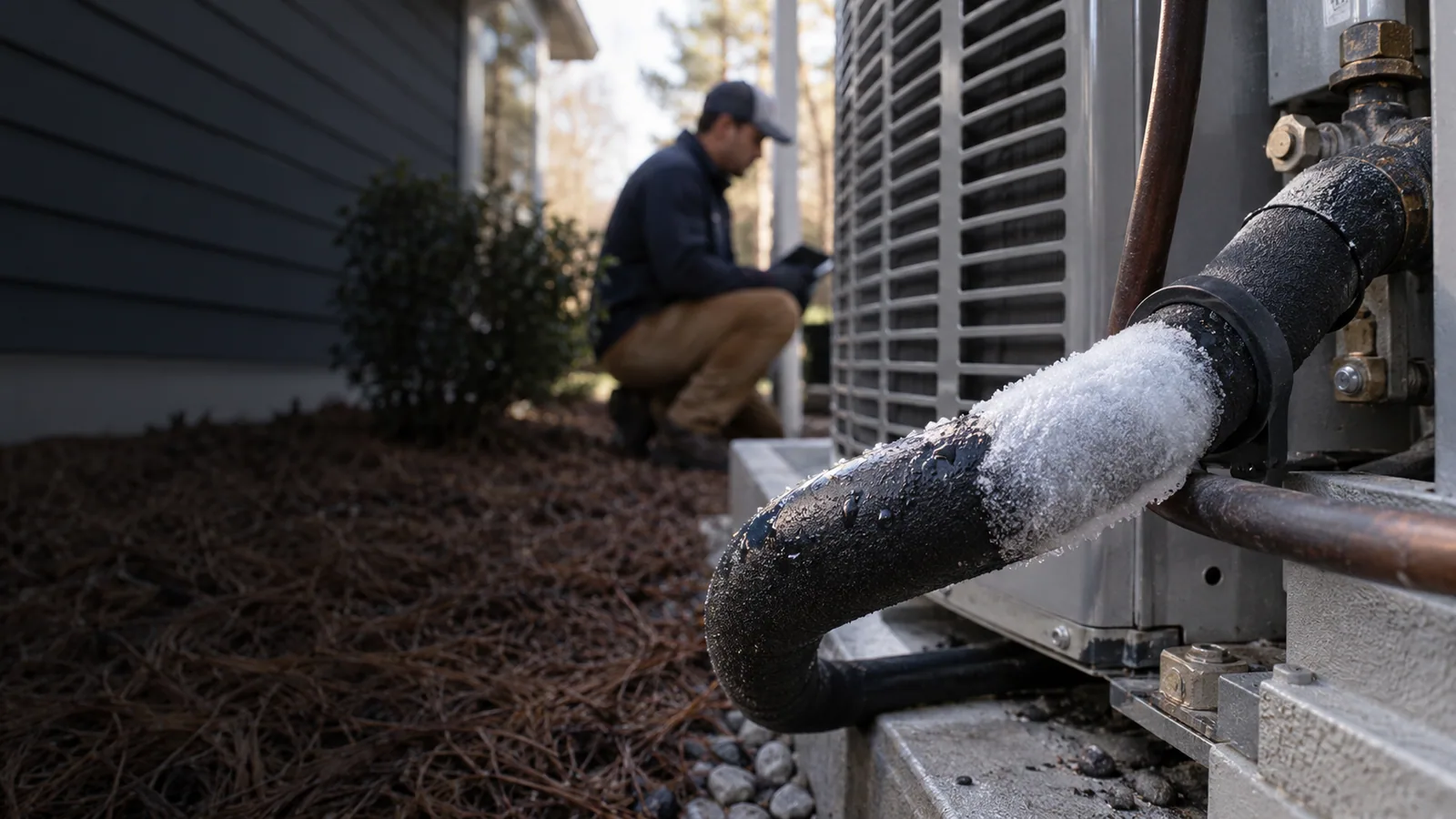
Why is there ice on my AC line?
Ice on an AC refrigerant line can accompany an indoor-coil freeze. Airflow restrictions, controls, or refrigerant conditions may be involved; line appearance alone cannot identify the failed part.
My evaporator coil is frozen.
Turn cooling off and arrange diagnosis. Protect the surrounding area from thaw water where safe. Do not chip ice from the coil or use heat tools to speed thawing.
The air conditioner is icing up.
Continued cooling can worsen icing and reduce airflow further. Check only the user-accessible filter and open registers; the system may need to thaw before a technician can evaluate normal operation.
What should I do when the AC freezes?
Stop cooling using the thermostat and follow the equipment's user instructions. Report ice location, airflow changes, and recent service. Do not restart repeatedly just because the visible ice has melted.
Ice is forming on the indoor unit.
Indoor-unit ice needs investigation even if cooling temporarily returns after thawing. Ask the technician to verify airflow and the refrigerant circuit rather than treating each freeze as an isolated event.
What to do next
When to get help
Use qualified service to identify and correct the cause before normal operation resumes. Thawing removes ice but does not repair the underlying fault.
Sources and further reading
These references support the topic's technical background. For equipment-specific procedures, use the instructions for the exact model; for permits and compliance, check with the responsible local authority.
Educational guidance from HVACentric. Conditions at a property require direct assessment; these pages do not diagnose equipment or certify an installation.